Quakers

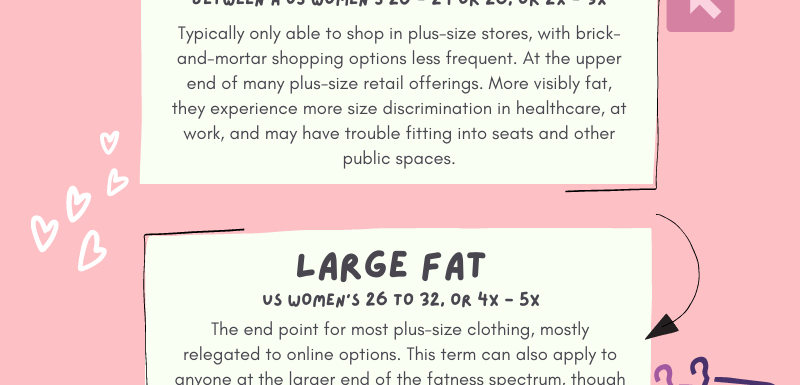
Fategories: UNDERSTANDING THE FATNESS SPECTRUM SMALL FAT BELOW A US WOMEN'S 18. OR 1X - 2X This is the smaller end of the fatness spectrum. Small fats can usually straddle the line between "fat" and "straight size." They can face medical discrimination & poor interpersonal treatment but are generally able to participate in public life with few restrictions based on size. MID FAT BETWEEN A US WOMEN'S 20 - 24 OR 26, OR 2X - 3X Typically only able to shop in plus-size stores, with brick-and-mortar shopping options less frequent. At the upper end of many plus-size retail offerings. More visibly fat, they experience more size discrimination in healthcare, at work, and may have trouble fitting into seats and other public spaces. LARGE FAT US WOMEN'S 26 TO 32, OR 4X- 5X The end point for most plus-size clothing, mostly relegated to online options. This term can also apply to anyone at the larger end of the fatness spectrum, though typically they place closer to the middle of the bell curve. SUPER FAT / INFINIFAT LARGER THAN A US WOMEN'S 32 BUT ALSO IT'S COMPLICATED! "Superfat" was created at a NOLOSE conference in 2008 & is meant to describe the largest & most underserved folks in fat communities. They face significant barriers to access in healthcare, clothing, public spaces, workplace discrimination, and beyond. "Infinifat" describes the same group & came into prominence around 2017, via Ash of The Fat Lip Podcast. Her widely-circulated size chart placed "Super Fat" below "Infinifat," which is often how it is used. Usage may vary, but both terms indicate people on the largest end of the spectrum. DEATH FAT Term created by fat activist & writer Lesley Kinzel in 2008. The term was not intended to have any specific size range or limitations, & can be used anyone who wishes to reclaim their "morbid" fatness. FLUFFYKITTENPARTY.COM

note: As you see in the title, this post will talk about antifatness. It will also talk about disordered eating stuff and racism that might be hard to read — I mention this because it would be hard for me to read if I wasn’t ready for it.

—–

A few years ago I was telling my now-15 year old how I felt like my “real self” was my thinner self, how I used to be. “Mama, that’s fat-phobic,” she said. At 12, she had introduced me to the podcast Maintenance Phase and was becoming even more incredibly wise than she had been before (and she was already wise!). “No way, I’m not fat phobic!” was the essence of my response. She pointed out that my saying my “real self” was my thinner self was rejecting the me who is now. That by rejecting my fat body, I was saying there was something wrong with it. Therefore: anti-fat. There were even more nuances in the things she said to me, but this was the gist.
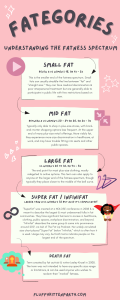
Fategories: UNDERSTANDING THE FATNESS SPECTRUM SMALL FAT BELOW A US WOMEN'S 18. OR 1X - 2X This is the smaller end of the fatness spectrum. Small fats can usually straddle the line between "fat" and "straight size." They can face medical discrimination & poor interpersonal treatment but are generally able to participate in public life with few restrictions based on size. MID FAT BETWEEN A US WOMEN'S 20 - 24 OR 26, OR 2X - 3X Typically only able to shop in plus-size stores, with brick-and-mortar shopping options less frequent. At the upper end of many plus-size retail offerings. More visibly fat, they experience more size discrimination in healthcare, at work, and may have trouble fitting into seats and other public spaces. LARGE FAT US WOMEN'S 26 TO 32, OR 4X- 5X The end point for most plus-size clothing, mostly relegated to online options. This term can also apply to anyone at the larger end of the fatness spectrum, though typically they place closer to the middle of the bell curve. SUPER FAT / INFINIFAT LARGER THAN A US WOMEN'S 32 BUT ALSO IT'S COMPLICATED! "Superfat" was created at a NOLOSE conference in 2008 & is meant to describe the largest & most underserved folks in fat communities. They face significant barriers to access in healthcare, clothing, public spaces, workplace discrimination, and beyond. "Infinifat" describes the same group & came into prominence around 2017, via Ash of The Fat Lip Podcast. Her widely-circulated size chart placed "Super Fat" below "Infinifat," which is often how it is used. Usage may vary, but both terms indicate people on the largest end of the spectrum. DEATH FAT Term created by fat activist & writer Lesley Kinzel in 2008. The term was not intended to have any specific size range or limitations, & can be used anyone who wishes to reclaim their "morbid" fatness. FLUFFYKITTENPARTY.COM
fluffykittenparty.com

This exchange added to the work I was already doing, healing from a lifetime of disordered eating. I’m now a mid-fat person and I can see why they say hindsight is 20/20. Just like my racism, when my eyes started opening to my own antifatness, I had to face some real ugliness in myself. As I began to experience the social costs of fatness for myself, I was able to see how shitty I had been to fat people in the past.

In my social circles throughout most of my 54 years, there have been almost no fat people, not even “small fat.” Just like we were almost all white, almost all from privileged socioeconomic classes, we were almost all quite thin. It wasn’t something I ever really thought about, it was just how it was.

But, looking back, why was it? Did I think people who were even approaching fatness were failures? (narrator voice: she did.) I considered myself to be fat at the time (I was not) and much of my life was spent trying to be not fat. “I have no problem with other people being fat, they’re beautiful! I just don’t like how I feel when I gain weight,” was my way. And now, OUCH, I understand how that is antifat. And also, it was a lie!

While I don’t remember specific examples of it, I am 100% sure there were times when someone might’ve approached our groups socially who we didn’t welcome because they didn’t fit in (because they were fat). I have no doubt in my mind that happened. Dehumanizing and horrible is how I treated fat people all the while being so very, very sure I didn’t and would never.

How do I know this now? I know this now because as a mid-fat person, I have experienced the almost imperceptible difference in acceptance in social settings. There’s a gaslighting quality about it, very similar to how I’ve heard Black people talk about racist micoaggressions. When I experience it, I know it. It’s not in my head, it’s not my imagination, it’s real. People treat me differently now that I am fat.

Antifatness is all around me. For example, I reached out to the people in my faith community who are in charge of arranging the chairs on Sundays suggesting we be sure there were at least a few seats not so close together so larger bodies would be accommodated. Not only did nothing change in the arrangement of seats, I didn’t hear back from anyone — I emailed several people and not one of them replied. Sure, “maybe they didn’t get the email” is a possibility but see how the mind goes there? No. Accepting fat bodies as fully human and as fully worthy of respect and consideration isn’t the norm in even our most progressive spaces (at least in the predominantly white ones — antifatness is an intersectional issue for sure).

I’ve experienced and lost the advantages of being in a conventionally attractive ( = thin) body and the upsides were omnipresent. Doctors treated me better, for example. I know what it’s like to’ve had those advantages and I know what it’s like living without them. I can only imagine (and have read and heard so I know) things are worse for people fatter than me.

If you are not fat — I don’t mean you sometimes “feel fat,” I mean if you are in a privileged body that passes on the thin side — I’d like to invite you to explore your own antifatness. When I began digging I was stunned by what I found. As I have been excavating and throwing away the trash, making space for newer fresher truths, all aspects of my life have been improving. Just like the practice of somatic abolition has been transforming how I move in the world especially in relation to my role in upholding white supremacy, practicing somatic abolition and using other recovery tools for my antifatness has brought me glimpses of new freedoms. These are good paths full of joy, gratitude, and solidarity.

If nothing else, maybe start listening to Maintenance Phase? There’s no one-fits-all solution to the work we thin (or previously thin) people need to do, but I’ve found this an incredibly helpful resource.
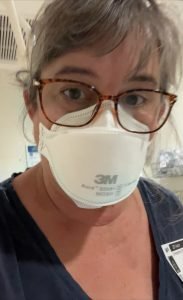
middle aged white woman with dark hair and glasses, she is wearing an N-95 maskEveryone I know, including myself, wishes COVID wasn’t an issue anymore.

I remain COVID-cautious — masking whenever I am with people outside of my immediate family, socializing almost exclusively outside, testing and using air filters if we are going to be in a group inside, etc. Most people I know, even those who were as cautious as I have been for the first three years or so, have moved on to acting like COVID isn’t a concern anymore. (My children are sweet, they mask when they are with me and they do sometimes mask in social gatherings but not all that often as far as I know.) Being COVID-cautious is exhausting and lonely. It’s also disappointing.

Why am I still masking everywhere? Of course, I’d like to not catch COVID again (I made a rare exception to my COVID cautious behavior last year and ended up getting it). And, as someone who lives with chronic diseases already I definitely don’t want to get long COVID. I won’t try to post data or statistics here trying to show how COVID-19 in general is still a serious threat—everyone knows how to Google—but long COVID is a heck of a chronic condition and I wouldn’t wish chronic illness on anyone.

Even more than these substantial personal concerns, I mask because I care about the most marginalized people in our communities. I mask because there are people who can not go places where people are not masking. I wear my mask most of the time even when I know it’s “low-risk,” because I want anyone who would be in a life or death situation if they got COVID (or any other respiratory illness, honestly) to know they are a part of our communities.

When my faith community gathers on Sunday mornings, almost no one is wearing a mask.* Because of this, I only attend via Zoom. Again, some of why I don’t attend in person is concern for my own health. But sitting in a room full of people in close quarters silently breathing together mostly unmasked for an hour fills me with deep grief and raging anger. How can these people not care about our disabled siblings? How can they be so callous? And, because these feelings of grief and anger well up more intensely when I am there in person, I’m not able to center in to worship. So I don’t attend. The same feelings flow when I am attending via Zoom, but I don’t want to lose my faith community entirely and I need that worship time.

Those of us who are still COVID cautious are few and far between. It is, as I mentioned, a lonely way to be. Of course I would love to visit with friends inside on a regular basis. But most of my friends aren’t masking anywhere, so the personal risk is too much. Of course I would love to attend Meeting for Worship every Sunday. But, as I mentioned, almost no one is masking and I can’t stomach being a part of a community so dismissive of immune compromised and disabled people.

It’s difficult to have conversations about this with friends, loved ones, and other people in my life because in agreeing to disagree about our “personal choices” or our “individual risk tolerance levels,” social lives remain not inclusive. In agreeing to disagree — in saying “it’s okay for you not to mask” — I am abandoning those among us who will be shut out from all social gatherings because of that agreement.

This situation is exhausting. It’s also unavoidable until more people start wanting to build inclusive communities for everyone.


* After a lot of pressure from me, and possibly from others, my faith community has been experimenting with “masks encouraged” Sundays once a month. I am so grateful for it, and I do attend in person on those Sundays whenever I can. But I’m still grieving and angry that these folks who claim to care so much about humanity seem perfectly comfortable telling our disabled and immune compromised siblings they don’t matter on other Sundays.

The true story behind the holiday most people call “Thanksgiving” involves a very rare moment of peace between (eventually to be called white) Europeans and Indigenous people. In our family over the last few years, it has felt really strange to celebrate what was an exception to the rule of the day; the rule of the day was my ancestors betraying and murdering Native people.
Last year, we celebrated Thanksgiving, but talked a lot about how complicated it was. Our 11 year old announced a few months ago that she was going to boycott Thanksgiving because of the harms white Europeans perpetrated against Indigenous people. Our family had some conversations about it and we have decided that we will no longer celebrate Thanksgiving.
We will, however, create our own new celebration. We are not simply re-naming the day. We will celebrate, and we will probably enjoy foods that we have shared over our lifetimes around this time of year. Our days of celebration will also include moments of solemnity and honor for all of the lives lost, the cultures crushed, and the overtaking of the land by greedy capitalists. We will live in the truth as best we can.
White supremacy culture is all we’ve known in our family, so far. What that means is we don’t have a “culture” that doesn’t relate to oppression of others. But, we white people can tease out of our family traditions, shared experiences, and other aspects of community those elements that may form a new culture or new cultures.
For us, we are trying out “Anticipating the Solstice” as our celebration. It will last two days (the last Wednesday and Thursday of November), so the kiddos can celebrate in both of their homes. The foods may vary from year to year, but there are sure to be many of the old standards we’ve grown up with. How we honor the true story of the first “Thanksgiving” will surely develop over time, too. We will start by using this as a reference. I know we will involved candles somehow, and silence. The rest we will work out as a family.
This is not going to be a “cheat.” This is not a way to celebrate Thanksgiving and still feeling good about it. We will not celebrate Thanksgiving as we have done before. We will join with our wider community in mourning the horrors our country was built on. And, on the same days, we will celebrate the bounty of our lives in joyful gratitude. Add to all of this the complexity that we know we are very lucky in our bounty, that too many people will be going without shelter, food, or family. We will recognize that, too.
As I was writing the last sentences to this post, a friend from our Quaker Meeting, Beth Bussiere, sent me an email about this very topic. I will leave you with her words: “What I found myself finally with was how interconnected lamentations and gratitude are. That without lamentations, without acknowledging the grief and the grievous, our gratitude can be misplaced or superficial. On the other hand, without gratitude, our lamentations can just pull us under.”

In the Quaker Meeting where I’m a member, we practice what is sometimes called “waiting worship,” or unprogrammed meeting. That means we mostly sit in silence together. Sometimes, people are led by Spirit (or God or however you want to describe it) to share something out loud with the rest of us. Today, a hymn came to me during worship. It didn’t “rise to the level of vocal ministry,” so I remained on mute (while I hum-sang!). This hymn from my childhood church came to me so strongly this morning that I would have (maybe?) sung it in Meeting if I could’ve remembered more than the Alleluias! I *almost* sang with the idea that I would hum the non-Alleluia parts.
If you are curious, with my Dad’s help (he’s retired minister of the ELCA), I found it — there are so many versions out there! — in the way I was hearing it in my head: https://youtu.be/FrDXw-8QtK0 was one from a Missouri Synod church (with the words), and another of just one person singing: https://youtu.be/tP9DfcMHVnk.
It will take some time for me to understand why this particular message came to me, though thoughts of hope and love (hope in action) following despair and acceptance come immediately to mind…

This message was shared on the e-group for the Portland Friends Meeting (Quakers), where I am a member. I am posting it here so I can share the whole message with others using just a link (instead of the full body of the message). I have added some links for those of you who aren’t already familiar with Quakers:
Hello Maine Friends,
New England Quakers have been meeting for the past few weeks to talk about the upcoming election. One part of that work is to prepare for a Spirit-led response in case the President does not respect the results. A handful of us at Portland Friends Meeting (“PFM”) have formed an informal group to help lead a local response, and this is a good time to share our thinking with the wider Maine Quaker community, and beyond.
Each of us has signed up with a nationwide initiative called Protect the Results. You can read all about it, and sign up yourself to get local updates, at www.protecttheresults.com. If you click on Resources you’ll find an extensive toolkit with lots of useful information.
The idea behind this initiative is that if the apparent loser of the election does not concede in a timely manner, then people across the nation will join grassroots nonviolent mass events. The first of these events is tentatively scheduled for 5 p.m. on Wednesday, November 4, the day after the election, if a rapid response is required that day. The Portland location is Deering Oaks Park, and there are several others throughout Maine.
Hopefully, none of this will be necessary and we’ll have a very ho-hum post-election transition. But rather than be caught unawares, we think it best to be prepared in advance.
We also encourage all Friends to take some steps now to be spiritually prepared and to brush up on our nonviolent direct action skills and understanding—even if you are not able to participate in in-person actions. If there is a long period of post-election uncertainty, there will no doubt be other training opportunities. We will also be looking for Friends who cannot attend in-person events to serve as elders, to hold us in the Light, and to otherwise support us spiritually.
For now, you can watch this two-hour training on De-Escalation and Safety, specifically tailored to the Protect The Results initiative.
Over the next few nights, there are also very useful online Choose Democracy trainings led by Quaker George Lakey.
Please let any of us know if you have any questions. We will be in touch around the election with any important updates.
And if anyone wants to join us tonight for the final NEYM Quaker Election prep, it’s not too late to register here.
Feel free to share this message with f/Friends throughout Maine and beyond.
Yours in the Light,
Anna Barnett
Brooke Burkett
Andy Burt (Midcoast Friends)
Sarah Cushman
Mary DeSilva
Jessica Eller
Christine Fletcher
Rob Levin
Wendy Schlotterbeck (Durham Friends)