activism

Originally published in December 2007, I’m reposting this as the Christian Nationalists have led us into another war. The me of today loves the Jesus who turned over tables in the temple, who washed the feet of sex workers, who trusted God and knew humans have to do the work of being in Beloved Community (scroll down the page to read about this). I hadn’t yet begun understanding the difference between charity and solidarity. We’re all learning, all the time, if we’re curious.

__________________________________

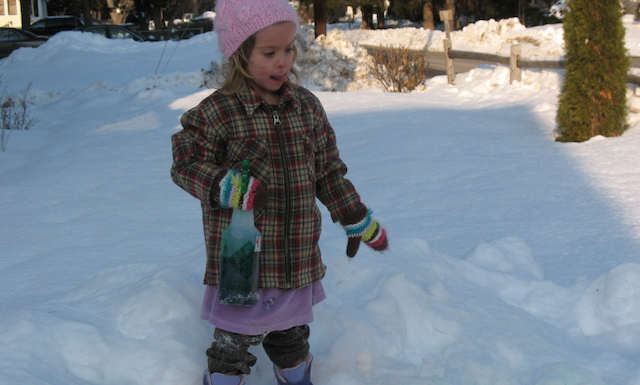
My four year old says, “I’m Mary and this is baby Jesus” and proceeds to sing all the words to “Oh Come, Oh Come, Emmanuel.” The time has come for me to explain why I’m christian. And why I’m not a Christian.

“I’m a Christian” vs. “I’m christian.”

First let’s be clear. I’m not “a Christian.” The right-wing fundamentalists have taken over that term with disturbing voracity. It makes me sick to my stomach to risk being grouped with such generally hateful sorts. Christian (with a C) now means to me, and to so many I talk with, an almost drug induced state of bliss (denial of questions or doubts), glazed eyes (from crying tears of joy when someone is “saved”), rigid rules. Mostly, Christian with a C requires following the strict-father model of living. It means a woman has no right to say what happens to her body. It means taxing the wealthy, stripping social services to nothing, and expecting the poorest among us to support it all. It means same-gender love is wrong. I want nothing to do with Christian with a C.

I am christian, though. I strive to live like Jesus did. That’s the essence of it, how I explain it to my daughter. In four year old terms, it’s pretty simple. Love everyone. Do whatever you can to help rid the world of injustice. Forgive yourself and others for our human frailties. Know that all you can do is your best and that is enough.

The magical fairyland of miracles.

But what about the “miracles,” the loaves and fishes, the healing blindness, bringing people back from the dead? Or, as Baby1 asked today at lunch, “Are angels real?” My answer is also pretty simple. I don’t get hung up on whether or not those things are literally true (it might lean into the sort of magical fairyland kind of thing, would it not?) or if they are only metaphors and lessons. I recognize that humans wrote the Bible, so the stories are most likely stories. I take the lessons from them and move on.

But what about the rising from the dead? Again, I don’t get hung up. Literal or not it isn’t a huge deal to me. The lessons that we’re all Okay, that we are always forgiven for our mistakes, and that the power of god is bigger than any human — that’s enough for me.

The truth is, though, at this moment I believe Jesus literally came back to life. When I’m in my “maybe it didn’t literally happen” times, it doesn’t scare me. Those thoughts fit perfectly in my faith, believing the truth of it as miracle or metaphor doesn’t change the message.

I recognize being raised by a minister and faithfully christian mother has a great deal to do with the likelihood that I’ll not find the story of the resurrection in the land with dragons, trolls, and fairies. Then again, as we all know, it could have pushed me farther away from believing the story. And, again, while I do happen to believe it actually happened, it’s not the biggest part of christianity for me.

I believe christianity is a religion of social justice. Jesus ate with and talked with women. With tax collectors. With sinners and untouchables of all sorts. Talking seriously with such non-people was rebelious enough, but to wash their feet or share a table with them was truly radical. He told poor people that they were the most special of all. He said people should love their enemies. He was a teacher.

After the sadness and revulsion I feel for those people I feel are butchering Jesus’ messages, those cap C’s, I realized there was another great obstacle preventing me from embracing the christian label.

I don’t believe Jesus would want our worship. The Jesus I understand would not want us to bow down to him. He would not want to be treated as someone more special than any other person. He certainly wouldn’t want me calling him “Lord.” Teacher, sure, but Lord, no way.

So, how could I be christian if I won’t pray to Jesus? That’s the question I grappled with for about the last ten years. But my truth has found me and I know now that, for me, being christian means I want to be as much like Jesus as possible. I want to be bold, courageous, and intelligent. I want to stay centered in my connection with god in all times of my life, as much as I can. I want to forgive myself and others every minute of every day. And, most of all, I want to help change the world. I want to help my neighbors near and far. I want people who are suffering to find justice, and I want to help make that happen.

What about Jesus as 100% god and 100% human?
The other hangup I had when I didn’t consider myself christian was the stance that Jesus was 100% God, different than us humans. As with so many of my understandings of my christianity, I realize it’s an issue of translation. The miracles were probably story telling tools. Jesus was a great healer (this is historical fact, not religious belief, though the ideas of what kind of healing he did are disputed), but was he as powerful as god? In my view, no. In my view, Jesus was astoundingly good at staying connected to god. He was clearly “centered” as we might say today. Serene. At peace most of the time. In no great hurry.

Again, I find Jesus to be a role model for my spiritual life. I know from my own experience that staying connected to what I call god keeps me relatively sane. I know peace when I am strongly connected to that strength. It’s my view that Jesus really got it– he found a way to stay connected more often than he was distracted by daily life. He was the ultimately god-connected person. Whether that was through prayer and meditation, through yoga, through great conversations with loved ones, or through times of quiet, I don’t know. But from what I know of the man named Jesus, I can tell he wasn’t easily distracted from his source of peace and strength.

But surely, you won’t stand for the Father Lord King garbage, will you?
No. I won’t stand for it. Mostly. My conception of god is not at all paternal. I certainly don’t think Jesus would dig that kind of reference in this day and age. But, in those days when women were dismissed and not counted, using paternal references to describe power and strength makes sense. In the days of rulers like Kings and Emperors it makes sense that Jesus and others would use the language of the day. Shortcuts, if you will, to explain they believed that god was extraordinarily powerful.
When I go to church with my parents, or continue our search for a church that meets our own family’s needs, I spend a lot of time translating so I can tolerate the paternal and inegalitarian concepts and language used. I usually don’t even like to use a capital letter G on god, it’s too high-and-mighty for me. Through the translation, though, I can still hear the message:

  • Be kind.
  • Be just.
  • Be brave.
  • Care for those who need help.
  • Don’t put up with shit from hateful people.
  • Love yourself and others.
So as Baby1 plays Mary, sings the Christmas hymns with all her might, and hears a bit more of the Christmas story every morning when we sing Oh Come, Oh Come Emmanuel at breakfast, I feel good being christian. I feel honored that our child asks such probing questions, forcing me to articulate in the simplest terms what I believe. I always begin by saying, “Well, not everyone believes this,” or, “Some people believe that is true, but I don’t.” But I almost always end up telling her the truest truth I know. The most important thing is that we try to love everyone in the world and help people who need it most.
Later that day she was playing store and announced, “I work for the giving store. We prepare food to give to people who don’t have enough.”

I believe Jesus would be glad.
.

The following is a letter I delivered to the manager at the Starbucks down the street from our home. True, buying locally would be more in line with our values, but the location of the store and the length of time we’ve been going there keep it close to our hearts. Please consider giving to the workers’ strike fund.

Dear Anissa,

Every morning my daughter and I drive by the Starbucks near our home, our “local coffee shop” that we know isn’t locally owned. We aren’t the types of people to typically go to Starbucks, but we have been going there — I have, in particular — several days a week for many years. I can’t honestly afford to do it, but I do it because I love the treat of it and the baristas are amazing.

It hasn’t even been a month. The strike started on November 13, 2025 (Red Cup Day). Our family will not cross that line. We believe the Starbucks workers, even those like in your store without a union, deserve to be a the table negotiating new contracts. There should be guarantees of fair labor practices, fair wages, staffing levels, and benefits. There are so many stories of workers who aren’t given their full hours to qualify for benefits, or workers asked to step up and do management work without increases in pay or authority. There are so many problems. Starbucks should negotiate in good faith with the workers.

I’m embarrassed to admit it, but I typically spend at least $100 a month at your store, oftentimes more. I live in poverty and coffee and treats from your store is one of my indulgences. We miss it. And, we will continue supporting the striking workers as long as Starbucks doesn’t meet them with reasonable negotiations.

I’m writing this note so you know that while your store isn’t unionized (I wish it was!) your customers support the union. And, we miss you.

–Heather Denkmire, just down the road from the Forest Ave branch here in Portland, Maine

PS I’m posting this on my personal blog, too, so I can share it more widely.

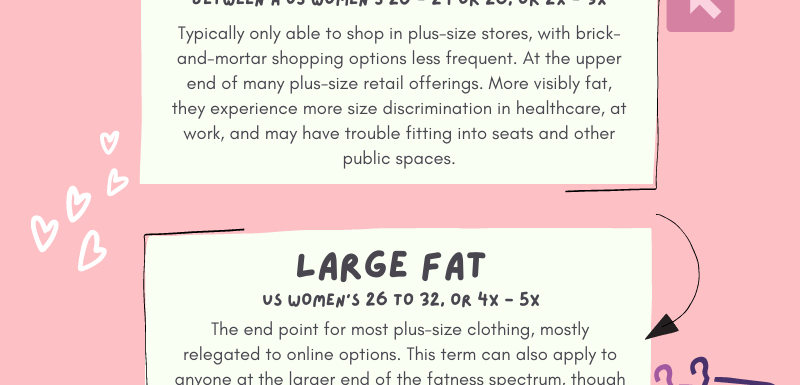
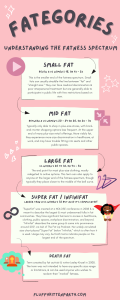
Fategories: UNDERSTANDING THE FATNESS SPECTRUM SMALL FAT BELOW A US WOMEN'S 18. OR 1X - 2X This is the smaller end of the fatness spectrum. Small fats can usually straddle the line between "fat" and "straight size." They can face medical discrimination & poor interpersonal treatment but are generally able to participate in public life with few restrictions based on size. MID FAT BETWEEN A US WOMEN'S 20 - 24 OR 26, OR 2X - 3X Typically only able to shop in plus-size stores, with brick-and-mortar shopping options less frequent. At the upper end of many plus-size retail offerings. More visibly fat, they experience more size discrimination in healthcare, at work, and may have trouble fitting into seats and other public spaces. LARGE FAT US WOMEN'S 26 TO 32, OR 4X- 5X The end point for most plus-size clothing, mostly relegated to online options. This term can also apply to anyone at the larger end of the fatness spectrum, though typically they place closer to the middle of the bell curve. SUPER FAT / INFINIFAT LARGER THAN A US WOMEN'S 32 BUT ALSO IT'S COMPLICATED! "Superfat" was created at a NOLOSE conference in 2008 & is meant to describe the largest & most underserved folks in fat communities. They face significant barriers to access in healthcare, clothing, public spaces, workplace discrimination, and beyond. "Infinifat" describes the same group & came into prominence around 2017, via Ash of The Fat Lip Podcast. Her widely-circulated size chart placed "Super Fat" below "Infinifat," which is often how it is used. Usage may vary, but both terms indicate people on the largest end of the spectrum. DEATH FAT Term created by fat activist & writer Lesley Kinzel in 2008. The term was not intended to have any specific size range or limitations, & can be used anyone who wishes to reclaim their "morbid" fatness. FLUFFYKITTENPARTY.COM

note: As you see in the title, this post will talk about antifatness. It will also talk about disordered eating stuff and racism that might be hard to read — I mention this because it would be hard for me to read if I wasn’t ready for it.

—–

A few years ago I was telling my now-15 year old how I felt like my “real self” was my thinner self, how I used to be. “Mama, that’s fat-phobic,” she said. At 12, she had introduced me to the podcast Maintenance Phase and was becoming even more incredibly wise than she had been before (and she was already wise!). “No way, I’m not fat phobic!” was the essence of my response. She pointed out that my saying my “real self” was my thinner self was rejecting the me who is now. That by rejecting my fat body, I was saying there was something wrong with it. Therefore: anti-fat. There were even more nuances in the things she said to me, but this was the gist.

Fategories: UNDERSTANDING THE FATNESS SPECTRUM SMALL FAT BELOW A US WOMEN'S 18. OR 1X - 2X This is the smaller end of the fatness spectrum. Small fats can usually straddle the line between "fat" and "straight size." They can face medical discrimination & poor interpersonal treatment but are generally able to participate in public life with few restrictions based on size. MID FAT BETWEEN A US WOMEN'S 20 - 24 OR 26, OR 2X - 3X Typically only able to shop in plus-size stores, with brick-and-mortar shopping options less frequent. At the upper end of many plus-size retail offerings. More visibly fat, they experience more size discrimination in healthcare, at work, and may have trouble fitting into seats and other public spaces. LARGE FAT US WOMEN'S 26 TO 32, OR 4X- 5X The end point for most plus-size clothing, mostly relegated to online options. This term can also apply to anyone at the larger end of the fatness spectrum, though typically they place closer to the middle of the bell curve. SUPER FAT / INFINIFAT LARGER THAN A US WOMEN'S 32 BUT ALSO IT'S COMPLICATED! "Superfat" was created at a NOLOSE conference in 2008 & is meant to describe the largest & most underserved folks in fat communities. They face significant barriers to access in healthcare, clothing, public spaces, workplace discrimination, and beyond. "Infinifat" describes the same group & came into prominence around 2017, via Ash of The Fat Lip Podcast. Her widely-circulated size chart placed "Super Fat" below "Infinifat," which is often how it is used. Usage may vary, but both terms indicate people on the largest end of the spectrum. DEATH FAT Term created by fat activist & writer Lesley Kinzel in 2008. The term was not intended to have any specific size range or limitations, & can be used anyone who wishes to reclaim their "morbid" fatness. FLUFFYKITTENPARTY.COM
fluffykittenparty.com

This exchange added to the work I was already doing, healing from a lifetime of disordered eating. I’m now a mid-fat person and I can see why they say hindsight is 20/20. Just like my racism, when my eyes started opening to my own antifatness, I had to face some real ugliness in myself. As I began to experience the social costs of fatness for myself, I was able to see how shitty I had been to fat people in the past.

In my social circles throughout most of my 54 years, there have been almost no fat people, not even “small fat.” Just like we were almost all white, almost all from privileged socioeconomic classes, we were almost all quite thin. It wasn’t something I ever really thought about, it was just how it was.

But, looking back, why was it? Did I think people who were even approaching fatness were failures? (narrator voice: she did.) I considered myself to be fat at the time (I was not) and much of my life was spent trying to be not fat. “I have no problem with other people being fat, they’re beautiful! I just don’t like how I feel when I gain weight,” was my way. And now, OUCH, I understand how that is antifat. And also, it was a lie!

While I don’t remember specific examples of it, I am 100% sure there were times when someone might’ve approached our groups socially who we didn’t welcome because they didn’t fit in (because they were fat). I have no doubt in my mind that happened. Dehumanizing and horrible is how I treated fat people all the while being so very, very sure I didn’t and would never.

How do I know this now? I know this now because as a mid-fat person, I have experienced the almost imperceptible difference in acceptance in social settings. There’s a gaslighting quality about it, very similar to how I’ve heard Black people talk about racist micoaggressions. When I experience it, I know it. It’s not in my head, it’s not my imagination, it’s real. People treat me differently now that I am fat.

Antifatness is all around me. For example, I reached out to the people in my faith community who are in charge of arranging the chairs on Sundays suggesting we be sure there were at least a few seats not so close together so larger bodies would be accommodated. Not only did nothing change in the arrangement of seats, I didn’t hear back from anyone — I emailed several people and not one of them replied. Sure, “maybe they didn’t get the email” is a possibility but see how the mind goes there? No. Accepting fat bodies as fully human and as fully worthy of respect and consideration isn’t the norm in even our most progressive spaces (at least in the predominantly white ones — antifatness is an intersectional issue for sure).

I’ve experienced and lost the advantages of being in a conventionally attractive ( = thin) body and the upsides were omnipresent. Doctors treated me better, for example. I know what it’s like to’ve had those advantages and I know what it’s like living without them. I can only imagine (and have read and heard so I know) things are worse for people fatter than me.

If you are not fat — I don’t mean you sometimes “feel fat,” I mean if you are in a privileged body that passes on the thin side — I’d like to invite you to explore your own antifatness. When I began digging I was stunned by what I found. As I have been excavating and throwing away the trash, making space for newer fresher truths, all aspects of my life have been improving. Just like the practice of somatic abolition has been transforming how I move in the world especially in relation to my role in upholding white supremacy, practicing somatic abolition and using other recovery tools for my antifatness has brought me glimpses of new freedoms. These are good paths full of joy, gratitude, and solidarity.

If nothing else, maybe start listening to Maintenance Phase? There’s no one-fits-all solution to the work we thin (or previously thin) people need to do, but I’ve found this an incredibly helpful resource.

When I’m in a flare, when the pain isn’t ignorable and the brain fog makes working almost impossible and the fatigue forces me to pause, I get wrapped up in my mind trying to explain to the world how fatigue is different than tired. Most people, I imagine, would prefer not to work full time. Most people, I’m pretty sure, would love to take a break and rest whenever they felt like it. Lots and lots of people live with chronic illness and pain or stress so overwhelming it’s difficult to function. I know this. So, when my body makes it almost impossible to keep up with my day-to-day tasks, part of me thinks “sure, you spoiled brat don’t take care of our responsibilities, everyone else has to keep going but you’re too lazy.”

Ugly, yes?

I wouldn’t speak to a friend that way, but there’s a part of me that’s sending a steady stream of this bile at me when my body won’t let me keep going.

There’s stuff going on in me, as an individual with my own life history and emotional makeup. And there’s also the general demanding force of racialized capitalism that we live under here in the USA. Produce produce produce. Tired? Keep going. Need a rest? You are failing. Bills too high? Tough luck, keep working.

Racialized capitalism wants to keep us too tired to organized. Too tired to imagine other alternatives.

When I hear the ugly voices in my head as I can not stay standing, can not keep typing, as I have to lie down, I can disentangle myself from my personal stuff, I can heal that. The force of racialized capitalism’s messages feel insurmountable, though. I imagine a crowd of people with lives much more difficult than mine calling me names and making me feel responsible for their suffering. How can I rest when I know others can’t?

Being a member of the oppressor groups brings a thick layer of “I don’t deserve rest” messages. Believing that lie hurts more than just me. It keeps me too weak to be a part of creating a better world for all of us. It prevents me from showing up for other humans when they need support. It’s letting racialized capitalism win if I believe that lie. We all deserve rest. There is no meritocracy for deserving the basic necessities of life — food, shelter, clothing, love, joy, and rest are the necessities I’m thinking of at the moment. At this moment, I can’t keep typing. I need to go lie down.

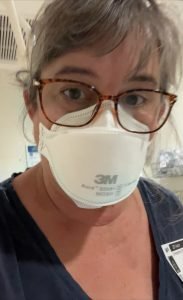
middle aged white woman with dark hair and glasses, she is wearing an N-95 maskEveryone I know, including myself, wishes COVID wasn’t an issue anymore.

I remain COVID-cautious — masking whenever I am with people outside of my immediate family, socializing almost exclusively outside, testing and using air filters if we are going to be in a group inside, etc. Most people I know, even those who were as cautious as I have been for the first three years or so, have moved on to acting like COVID isn’t a concern anymore. (My children are sweet, they mask when they are with me and they do sometimes mask in social gatherings but not all that often as far as I know.) Being COVID-cautious is exhausting and lonely. It’s also disappointing.

Why am I still masking everywhere? Of course, I’d like to not catch COVID again (I made a rare exception to my COVID cautious behavior last year and ended up getting it). And, as someone who lives with chronic diseases already I definitely don’t want to get long COVID. I won’t try to post data or statistics here trying to show how COVID-19 in general is still a serious threat—everyone knows how to Google—but long COVID is a heck of a chronic condition and I wouldn’t wish chronic illness on anyone.

Even more than these substantial personal concerns, I mask because I care about the most marginalized people in our communities. I mask because there are people who can not go places where people are not masking. I wear my mask most of the time even when I know it’s “low-risk,” because I want anyone who would be in a life or death situation if they got COVID (or any other respiratory illness, honestly) to know they are a part of our communities.

When my faith community gathers on Sunday mornings, almost no one is wearing a mask.* Because of this, I only attend via Zoom. Again, some of why I don’t attend in person is concern for my own health. But sitting in a room full of people in close quarters silently breathing together mostly unmasked for an hour fills me with deep grief and raging anger. How can these people not care about our disabled siblings? How can they be so callous? And, because these feelings of grief and anger well up more intensely when I am there in person, I’m not able to center in to worship. So I don’t attend. The same feelings flow when I am attending via Zoom, but I don’t want to lose my faith community entirely and I need that worship time.

Those of us who are still COVID cautious are few and far between. It is, as I mentioned, a lonely way to be. Of course I would love to visit with friends inside on a regular basis. But most of my friends aren’t masking anywhere, so the personal risk is too much. Of course I would love to attend Meeting for Worship every Sunday. But, as I mentioned, almost no one is masking and I can’t stomach being a part of a community so dismissive of immune compromised and disabled people.

It’s difficult to have conversations about this with friends, loved ones, and other people in my life because in agreeing to disagree about our “personal choices” or our “individual risk tolerance levels,” social lives remain not inclusive. In agreeing to disagree — in saying “it’s okay for you not to mask” — I am abandoning those among us who will be shut out from all social gatherings because of that agreement.

This situation is exhausting. It’s also unavoidable until more people start wanting to build inclusive communities for everyone.


* After a lot of pressure from me, and possibly from others, my faith community has been experimenting with “masks encouraged” Sundays once a month. I am so grateful for it, and I do attend in person on those Sundays whenever I can. But I’m still grieving and angry that these folks who claim to care so much about humanity seem perfectly comfortable telling our disabled and immune compromised siblings they don’t matter on other Sundays.